
Running an e-commerce business gets complicated fast. One day, you’re managing ten orders; the next, you’re juggling hundreds across multiple channels. Without the right system in place, things start slipping—inventory goes out of sync, orders get delayed, and reports rarely match what’s happening on the ground.
As per a report by Statista, 43% of online retailers cited inventory and supply chain management as their biggest operational challenge. When systems don’t talk to each other—sales, stock, finance, or delivery—it creates gaps that cost time, money, and customer trust.
Enterprise Resource Planning (ERP) systems solve this by bringing all business functions under one platform. From inventory and finance to customer data and shipping, ERP automates routine operations and gives teams a single source of truth. It’s no longer just a back-office system; it’s a growth enabler for modern e-commerce.
In this blog, we’ll look at ERP benefits for e-commerce businesses, tips for choosing the right ERP, and how Ksolves helps brands succeed with ERP.
6 Key Benefits of ERP for E-Commerce Businesses
Running an e-commerce business requires speed, accuracy, and seamless coordination across multiple functions. Implementing an ERP system can unify your operations and unlock new levels of efficiency and growth.
Here are a few ERP benefits for e-commerce:
1. Centralized Inventory and Order Management
One of the biggest challenges e-commerce businesses face is managing inventory across multiple sales channels. Manual tracking can lead to over-selling, stockouts, or inaccurate order fulfillment, all of which hurt customer satisfaction and revenue. An ERP system solves this by centralizing inventory and order management in a single platform.
With ERP, your inventory is updated in real time as orders come in, returns are processed, or stock is replenished. This ensures that what customers see on your website or marketplaces like Amazon, eBay, or Shopify reflects actual availability.
Suppose you’re selling the same product on Shopify and Amazon. Without ERP, you’d need to manually reduce inventory on both platforms after each sale. But with an ERP system like Odoo, once a product is sold on Amazon, the inventory automatically updates across Shopify and your backend. This minimizes the risk of selling products you no longer have in stock and offers faster, more reliable fulfillment.
2. Streamlined Accounting and Financial Reporting
Handling accounting manually, especially when orders flow in from multiple platforms, can quickly become overwhelming. Payments from different gateways, varying tax rates by region, refunds, discounts, and shipping charges can lead to confusion and errors if tracked across scattered spreadsheets or disconnected tools.
An ERP system simplifies this by automatically syncing all financial transactions into one central accounting module. This includes sales orders, invoices, tax calculations, payment statuses, and returns. The result is real-time visibility into your financial health and significantly reduced risk of human error.
Let’s say you make a sale on Flipkart. The ERP instantly captures the order details and records them in your accounting system, complete with tax amounts, payment method, and customer details. This eliminates the need for manual reconciliation at the end of the day, week, or month. Moreover, your finance team can generate real-time profit & loss statements, GST filings, and cash flow reports with just a few clicks.
3. Improved Customer Experience and Faster Fulfilment
In today’s competitive e-commerce environment, customers expect more than just great products. They want fast delivery, real-time updates, and seamless post-purchase support. Manual processes or disconnected systems often lead to shipping delays, missing tracking information, or poor customer communication.
An ERP system makes sure that your warehouse, logistics, finance, and support teams are all in sync. The moment an order is placed, the ERP automates the workflow, triggering tasks like picking, packing, invoicing, and shipping without manual intervention.
For example, a customer places an order on your website. The ERP automatically:
- Notifies the warehouse to prepare the package
- Generates the invoice
- Assigns a courier
- Sends the tracking link to the customer via email or SMS
This kind of instant coordination boosts customer satisfaction and reduces shipping errors or delays.
4. Real-Time Data for Smarter Decisions
When your business data is spread across multiple spreadsheets or apps, getting a clear picture of your operations becomes difficult. ERP systems solve this by pulling everything into centralized, real-time dashboards, from sales and inventory to returns and customer feedback.
With accurate, up-to-date data at your fingertips, you can spot trends, identify issues early, and make informed decisions faster.
If your ERP dashboard shows a spike in returns for a particular product, you can immediately investigate. Maybe the size chart is misleading, or there’s an issue with packaging quality. By catching this early, you reduce further losses and improve the customer experience proactively.
5. Reduced Operational Costs and Time Savings
Running an e-commerce business involves hundreds of repetitive tasks daily, like updating inventory, sending order confirmations, generating invoices, and preparing shipping labels. Relying on manual effort for these tasks not only slows down operations but also increases payroll expenses and leaves room for human error.
An ERP system automates these routine activities, so that your team can focus on more strategic tasks like growth planning, marketing, or customer engagement. Automation also ensures that every order is processed accurately and consistently, without delays or bottlenecks.
For instance, when an order is placed, the ERP instantly sends a confirmation email to the customer, generates and stores the invoice, creates and prints the shipping label, and updates the inventory count, all automatically. This eliminates the need for manual clicks or switching between applications.
6. Better Supplier and Purchase Management
Efficient supply chain management is critical for e-commerce success, especially when demand can shift rapidly. Without proper visibility into stock levels and supplier transactions, you risk over-ordering, understocking, or delayed replenishments.
An ERP benefit for e-commerce systems gives you full control over your supplier relationships and purchase orders. You can track every purchase—what was ordered, when it will arrive, and how much it cost—and even set automated reorder points so that inventory levels are always optimized.
Say you’re selling a product that’s suddenly trending. As inventory begins to dip below a predefined threshold, the ERP sends an alert to your procurement team or automatically generates a purchase order to your supplier. This is crucial so that stock is replenished before it runs out, keeping your sales momentum going.
Tips for Choosing the Right ERP for E-Commerce
Choosing the right ERP for your e-commerce business means finding a system that fits your workflows, connects with your existing tools, and scales as you grow. This section covers key factors like cloud options, integrations, pricing, and vendor support to help you make the right decision.
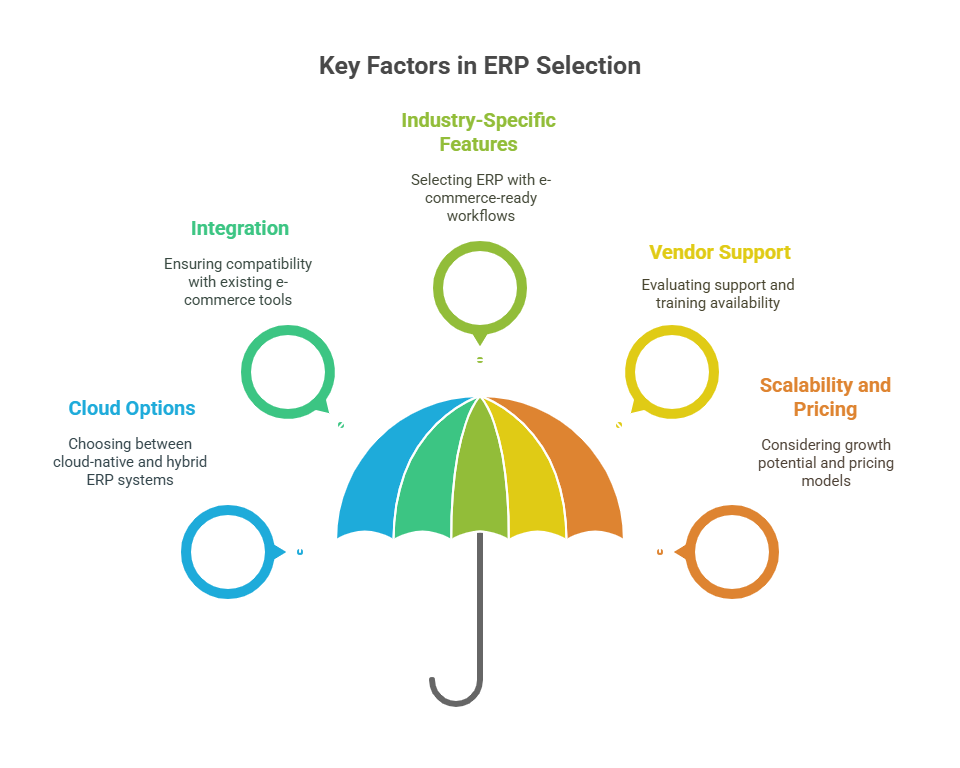
1. Cloud-native vs. Hybrid Options
A cloud-native ERP runs fully online—no installation, no hardware, and easy updates. It’s accessible from anywhere and ideal for remote teams and fast-growing businesses.
A hybrid ERP combines offline and online access. It may suit businesses with custom legacy systems or strict data hosting requirements.
Tip: Go for a cloud-native ERP if you want low maintenance, better flexibility, and easier upgrades.
2. Integration with Your Existing E-Commerce Stack
Your ERP must work well with the tools you already use—whether it’s Shopify, Amazon, WooCommerce, Razorpay, Shiprocket, or Tally. Native integrations save hours of manual work and reduce data errors.
Tip: Always check if the ERP supports real-time sync with your sales channels, payment gateways, and delivery partners.
3. Industry-Specific Features
Generic ERPs might miss features e-commerce businesses need, like batch tracking, returns automation, or marketplace syncing. Choose one with e-commerce-ready workflows to avoid custom builds.
Tip: Look for built-in features like return management, warehouse transfers, product bundling, and multi-location inventory.
4. Vendor Support and Training Availability
Even the best ERP fails without support. You need a partner who offers onboarding, proper documentation, and ongoing training—especially if your team is non-technical.
Tip: Ask if they offer dedicated support staff, weekend availability, and user training modules during implementation.
5. Scalability and User-Based Pricing
Your ERP should grow with you. As you add new SKUs, expand warehouses, or open new markets, it should handle everything without slowing down. Some ERPs charge per user, while others have tiered pricing.
Tip: Choose a platform that can handle future growth and offers flexible pricing based on users, orders, or features, not just flat fees.
How Ksolves Can Assist in Selecting the Right ERP for Your E-Commerce Business
Choosing the appropriate ERP system is crucial for streamlining operations and supporting growth in your e-commerce business. Ksolves offers expert ERP consulting services to guide you through this process.
- ERP Planning and Strategy: Evaluating your business needs to create a detailed ERP adoption and implementation roadmap.
- ERP Consulting: Guiding you in selecting, implementing, and optimizing ERP systems tailored to your specific requirements.
- ERP Implementation: Overseeing the deployment, configuration, and integration of ERP systems to ensure seamless operation.
- ERP Software Optimization: Enhancing efficiency through process improvements and system adjustments.
- ERP Training and Support: Providing training for your employees and ongoing support for effective system usage.
- ERP Change Management: Managing the transition to ERP with minimal disruption to your business operations.
Ksolves has successfully helped e-commerce businesses optimize their ERP systems. For example, in a recent project, we implemented Odoo with a WooCommerce connector to streamline order processing, inventory management, and reporting, resulting in faster operations and improved efficiency. This demonstrates how our ERP solutions can deliver tangible business value.
With a team of over 300 certified professionals and a client retention rate of 90%, Ksolves ensures that your ERP solution aligns with your business goals and scales with your growth. So, contact us today!
Leave a Reply